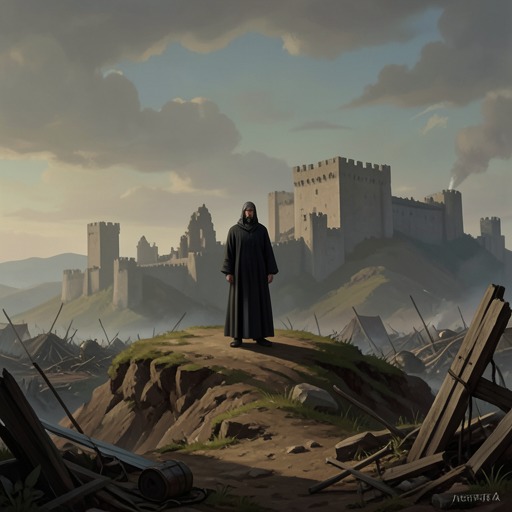
Yanzhou
The Romance of the Three KingdomsYanzhou is the provincial base from which Cao Cao builds his power after defeating the Yellow Headband rebels. Its importance is made unmistakable when Lü Bu seizes much of the province: threatened with losing his only base, Cao Cao leaves the siege of Xuzhou to return. The struggle for Yanzhou turns territorial control into a test of whether Cao Cao can preserve the political and military foundation of his rise.
A base for Cao Cao’s power
After defeating the rebels and receiving the surrender of more than three hundred thousand former Yellow Headband soldiers, Cao Cao selects the best of them for his own army. He bases himself in Yanzhou, away from the imperial capital, and builds what amounts to a separate court there, gathering capable advisers and followers around him. Yanzhou is therefore more than a place to station troops: it is the territory where his military strength becomes an independent political center.
The province also figures in Cao Cao’s personal display of success. Once powerful, he sends for his father and extended family so they can see his standing. Their journey toward Yanzhou passes through Xuzhou, where Tao Qian arranges an escort; after the family is killed by Zhang Kai and his men, Cao Cao wrongly holds Tao responsible. His invasion of Xuzhou follows from that mistaken accusation, and the campaign brings his own Yanzhou base into danger.
Lü Bu’s seizure and Cao Cao’s return
While Cao Cao besieges Xuzhou, a messenger brings word that Lü Bu, allied with rebels, has attacked Yanzhou and taken most of the province. The news changes the immediate stakes: Cao Cao is threatened not just with losing ground elsewhere but with losing the territory on which his power depends. He responds to Xuande’s appeal and abandons the siege to hurry back.
Cao Cao initially underestimates the strength of Lü Bu’s enlarged army. Near Puyang, Lü Bu’s forces repel his attack. Cao Cao then tries a night assault on the camp; although it gains ground at first, Lü Bu’s generals mount a coordinated defense, turning the attack into a retreat. With Cao Cao’s escape routes blocked, Dian Wei fights through the encircling force and rescues him. Yanzhou’s recovery is thus represented not as a simple return to secure rule, but as a dangerous contest in which Cao Cao himself comes close to being captured or killed.
Strategic and narrative significance
The crisis in Yanzhou interrupts Cao Cao’s punitive campaign in Xuzhou and redirects his attention to survival. It also exposes the vulnerability behind his growing power: an army and court assembled in a province can be imperiled when an opponent captures its territory. The province’s value lies precisely in this connection between land, military forces, advisers, and political authority.
Elsewhere, Yanzhou remains a point of reference in the story’s strategic geography. Kong Ming later identifies Cao Cao as commanding an immense force and holding the emperor, while advising Xuande to treat Sun Quan as a possible ally and focus on Jingzhou. Against that wider contest for territory and legitimacy, Cao Cao’s earlier struggle to retain Yanzhou shows how precarious the foundations of a warlord’s power can be: before he can dominate rivals, he must keep hold of the province that sustains his own position.